Made by TRACTR
An agent that files our meeting transcripts
Every recorded meeting ends up in the right Drive folder, with nobody touching it. Here is what this agent does, how it decides, and what we learned.

Olivier Tarbès, CEO & Founder4 min read
How the agent works
In this article
We record and transcribe our meetings with Fathom, across several accounts. It is one of the agents that work for TRACTR every day.
The problem
Transcripts pile up far from their context: a client, a product, an internal meeting. Filing them by hand takes time, and nobody keeps it up to date. The information exists, but you cannot find it when you need it.
What the agent does
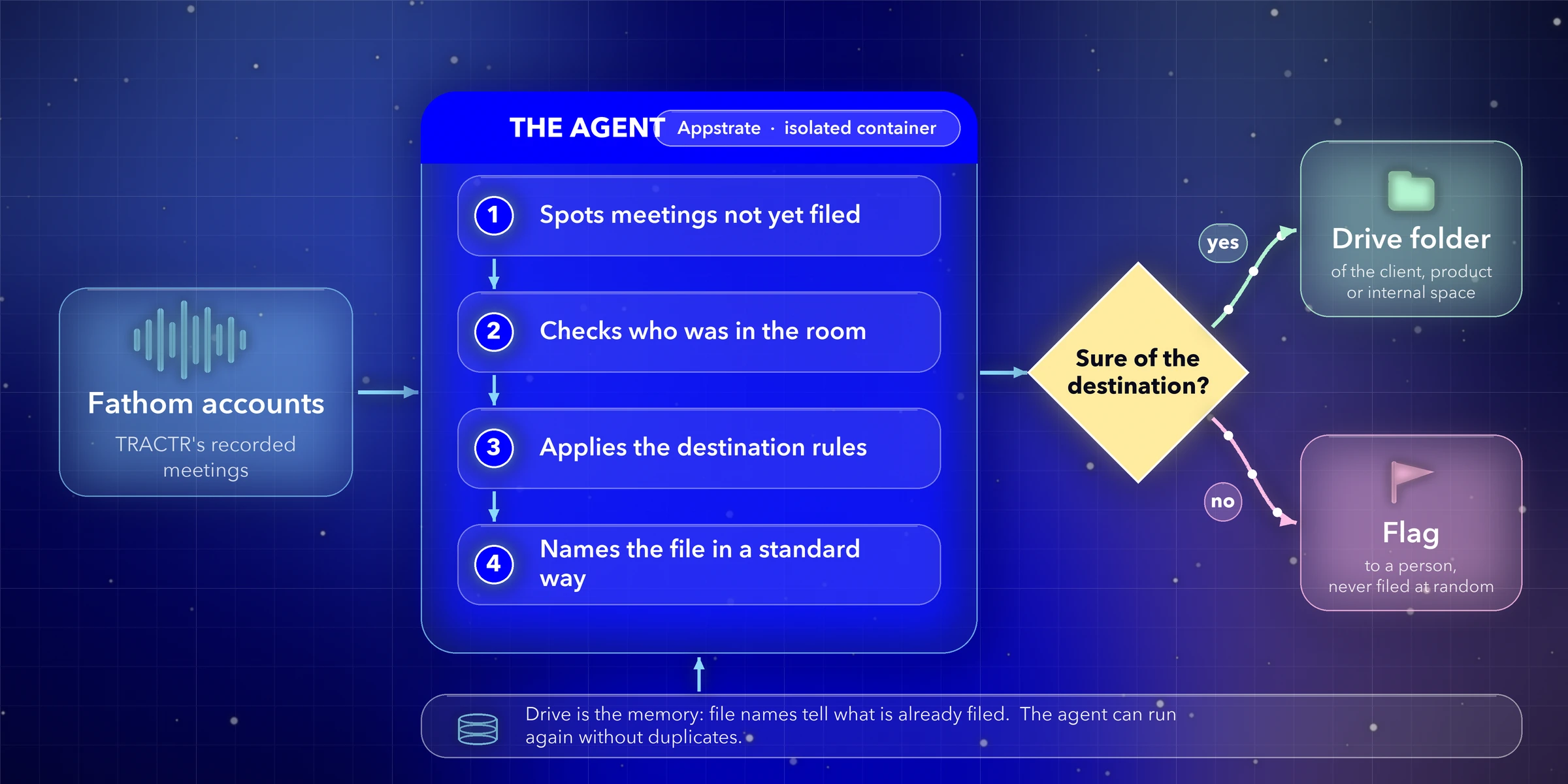
It goes through the meetings of TRACTR's Fathom accounts and spots the ones not yet filed. For each, it drops the transcript into the Drive folder of the right client, product or internal space, under a standard name.
It runs on Appstrate, our open source platform: each run happens in an isolated container, and the agent never sees the credentials of the services it uses.
How it decides
Three rules, written down rather than left to intuition:
- Participants before the title. The title of a calendar event rarely says what it is about. The people in the room do.
- Drive as memory. The agent keeps no separate index: the names of the files already there tell it what is done. It can be run again safely, with no duplicates.
- When in doubt, it does not choose. An uncertain destination is flagged to a person, never filed at random.
What we learned
- The first useful agent is often a modest one: a repetitive task and a clear destination rule.
- Making the folder the source of truth avoids maintaining a tracking database that goes stale.
- Planning for "I don't know" is the most important part. A flag costs a minute; a wrong filing costs trust.
Take it to your company
The same pattern applies wherever documents arrive from several sources and must end up in the right place: supplier invoices, meeting notes, case files. The agent reads, decides by explicit rules, files, and flags what it doubts.
For your project
A flow like this at your company?
We start by scoping: finding the repetitive task that deserves an agent, and testing a first version.
The next step
What are we moving forward together?
An idea, an existing product, a task that takes too long. Tell us where you're starting from.
Let's talk about your projectA first conversation to understand your context.